We are delighted to share a first look at one of the cornerstone results of our project: the RESPONSE Competence Framework for Crisis Resilience in Social Entrepreneurship. Developed under the leadership of Social Innovation Cluster CLM, with contributions from all partners, the framework will soon be available to download in English, Spanish, German and Ukrainian.
Why a framework?
Throughout the early phases of RESPONSE, one finding came up again and again. Crisis resilience is not yet properly embedded in adult education or social entrepreneurship support. Educators want to help, and social entrepreneurs want to learn, but there has been no shared reference point describing which competences actually make a social enterprise more resilient.
The framework fills that gap. It provides a common European language for the skills, knowledge and attitudes social entrepreneurs need before, during and after a crisis, and it will act as the foundation for everything else we build: the RESPONSE Curriculum, our training modules and toolbox, the educator package and the digital self-assessment application.
Built on evidence
The framework is grounded in research carried out by partners in Ireland, Germany, Spain and Ukraine. This combined desk research, a review of national evidence, consultations with social entrepreneurs, trainers and support organisations, and a cross-country analysis comparing what we found.
That comparison showed that resilience needs differ depending on legal frameworks, funding systems, local conditions and exposure to crisis. But it also revealed a clear set of shared priorities that cut across every context, and those priorities shape the framework’s structure.
Three areas, nine competences, three levels
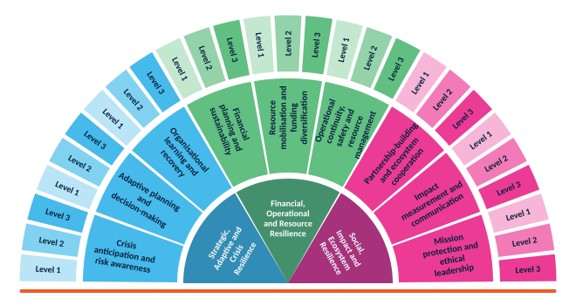
The framework is deliberately simple to use, while still reflecting how complex resilience really is. It is organised around three competence areas, each containing three specific competences.
Area 1: Strategic, Adaptive and Crisis Resilience. The capacity to anticipate risks, make decisions under uncertainty, adapt strategies and learn from crisis.
- Crisis preparedness and risk awareness
- Adaptive planning and decision-making
- Organisational learning and adaptive leadership
Area 2: Financial, Operational and Resource Resilience. The capacity to manage financial sustainability, mobilise resources, diversify funding and keep essential operations running.
- Financial planning and sustainability
- Resource mobilisation and funding diversification
- Operational continuity, safety and resource management
Area 3: Social, Impact and Ecosystem Resilience. The capacity to build partnerships, communicate impact, protect the social mission and act ethically within wider ecosystems.
- Partnership-building and ecosystem cooperation
- Impact measurement and communication
- Mission protection and ethical decision-making
Each of the nine competences is described through its knowledge, skills and attitudes, and through three progressive levels of development:
- Awareness: understanding the competence and recognising why it matters.
- Application: using it in practice through tools, methods and real situations.
- Integration: embedding it into organisational strategy, culture and decision-making, and supporting others to do the same.
This progression means the framework is not just descriptive. It is a practical teaching tool that helps educators pitch learning at the right level, whether they are working with someone just starting out or an experienced practitioner.
Who is it for?
The framework has been designed with several groups in mind:
- Adult educators, trainers and facilitators, as a reference for designing modules, learning outcomes, activities and assessments.
- Social entrepreneurs, as a self-reflection tool to identify strengths, gaps and priorities.
- Business support organisations, incubators and social economy networks, to strengthen mentoring, advisory and capacity-building services.
- Policymakers and local authorities, as a common language for understanding what resilient social enterprise ecosystems need.
It is flexible by design. Rather than imposing a one-size-fits-all model, it offers a shared structure that can be adapted with local examples, case studies and terminology to suit national and regional realities.
What comes next
The framework is the starting point, not the finish line. Over the coming months it will be translated into the RESPONSE Curriculum and our modular training resources, and it will shape the competence areas assessed by our digital self-assessment application.
Keep an eye on our website and social channels for the launch. When it goes live, we would love to hear how you plan to use it in your own training, mentoring or support work.